| Globular Clusters |

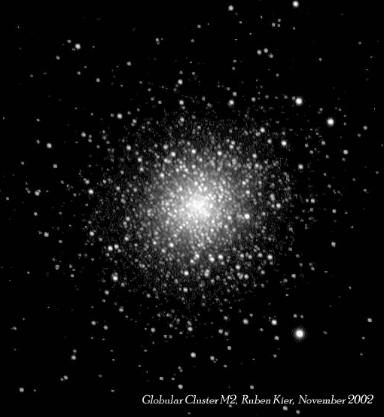
M2 is a globular cluster in the
constellation Aquarius. Like other
globular clusters, it is essentially
an island of numerous suns that
formed at a similar time, about 13
billion years ago at the time of the
formation of our galaxy. Globular
clusters orbit at the periphery of
our galaxy, with about a hundred
of them scattered around the
Milky Way galaxy. M2 contains
about 100,000 stars, closely
packed together at a distance of
37,000 light years. If you lived
around one of the stars near the
center, thousands of nearby stars
would brightly illuminate your
"night skies�!
The photo is a combination of 4 x
90-second exposures through a
Celestron 14 and a SBIG 1001E
digital CCD camera.
constellation Aquarius. Like other
globular clusters, it is essentially
an island of numerous suns that
formed at a similar time, about 13
billion years ago at the time of the
formation of our galaxy. Globular
clusters orbit at the periphery of
our galaxy, with about a hundred
of them scattered around the
Milky Way galaxy. M2 contains
about 100,000 stars, closely
packed together at a distance of
37,000 light years. If you lived
around one of the stars near the
center, thousands of nearby stars
would brightly illuminate your
"night skies�!
The photo is a combination of 4 x
90-second exposures through a
Celestron 14 and a SBIG 1001E
digital CCD camera.
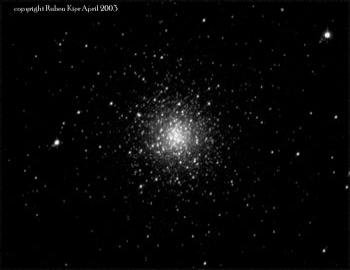
Globular Cluster M3 in the constellation
Canes Venatici was dicovered in 1764 by
Messier. It lies at a distance of 32,000
light years, and contains about a half
million stars. The image is not as bright
as the image of M2 because I used a
smaller telescope with smaller CCD
camera, but nonetheless a pleasing image
to acquire from the backyard. Ten 30
second exposures with the ST-10MXE
camera were combined, using a 4"
refractor.
Canes Venatici was dicovered in 1764 by
Messier. It lies at a distance of 32,000
light years, and contains about a half
million stars. The image is not as bright
as the image of M2 because I used a
smaller telescope with smaller CCD
camera, but nonetheless a pleasing image
to acquire from the backyard. Ten 30
second exposures with the ST-10MXE
camera were combined, using a 4"
refractor.
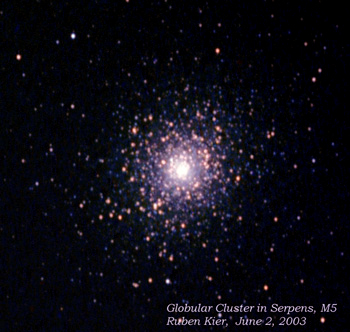
Globular Cluster M5 lies at a distance
of 25,000 light years in the
constellation Serpens. Like M3, it
was discovered by Messier in 1764.
This was my first color image from
my home, using a CFW8 filter wheel,
with a total of 7 minute exposures
each in luminance, red, green, and
blue, for a total imaging time of 28
minutes. The luminance was at full
resolution of the ST10XME camera,
and RGB were binned 2x2, all
through a 4" refractor.
of 25,000 light years in the
constellation Serpens. Like M3, it
was discovered by Messier in 1764.
This was my first color image from
my home, using a CFW8 filter wheel,
with a total of 7 minute exposures
each in luminance, red, green, and
blue, for a total imaging time of 28
minutes. The luminance was at full
resolution of the ST10XME camera,
and RGB were binned 2x2, all
through a 4" refractor.
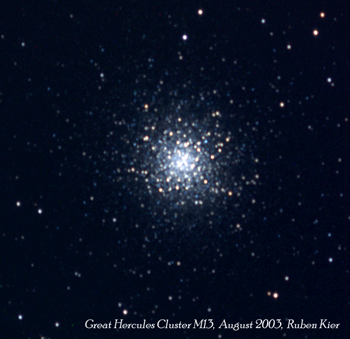
M13 has been called the Great
Hercules Cluster because it is the
brightest globular cluster visible from
the Northern Hemisphere. WIth about a
half million suns at a distance of 23,000
light years, it can be easily seen by the
naked eye from clear dark skies as a
"fuzzy star." This image was the sum
of 13 red, 18 green, and 20 blue
90-second exposures, with an ST-10
XME CCD camera binned 1x1 through
a 4" refractor. Total image time 76.5
minutes!
If you look at all 4 images on this page,
you will notice that all globular clusters
look almost alike.
Hercules Cluster because it is the
brightest globular cluster visible from
the Northern Hemisphere. WIth about a
half million suns at a distance of 23,000
light years, it can be easily seen by the
naked eye from clear dark skies as a
"fuzzy star." This image was the sum
of 13 red, 18 green, and 20 blue
90-second exposures, with an ST-10
XME CCD camera binned 1x1 through
a 4" refractor. Total image time 76.5
minutes!
If you look at all 4 images on this page,
you will notice that all globular clusters
look almost alike.


Music: Star Trek & Next Generation themes