| Triangulum Galaxy M33 |
The Pinwheel Galaxy, M33, floats 2.3 million light years away, at the same distance as the Great Andromeda Galaxy. Its diameter of 50,000 light years is only a third of the
Andromeda Galaxy, so it appears substantially smaller through binoculars and telescopes. Nonetheless, even a small telescope at a dark site can detect the spiral arms. In this
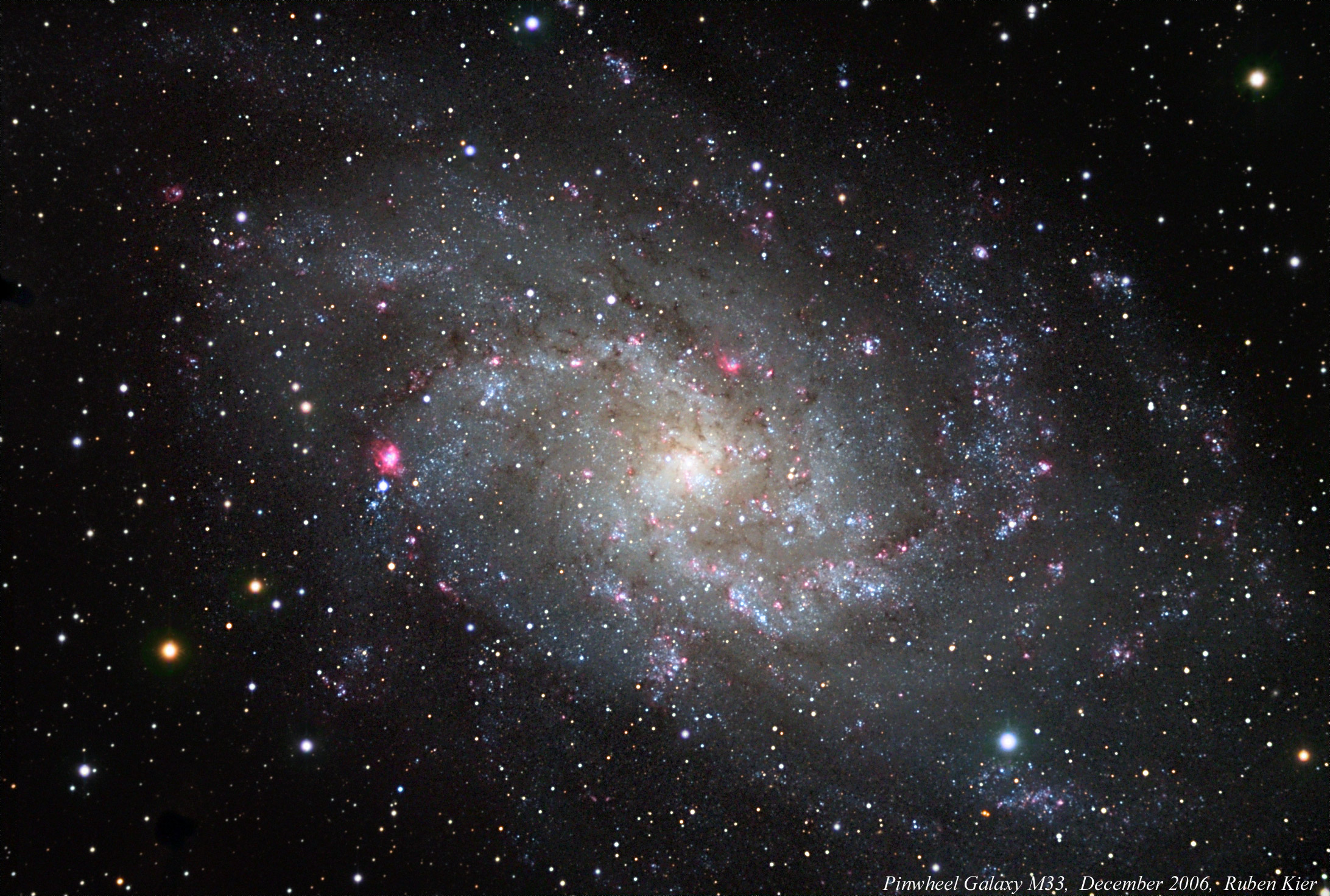
detailed photograph, one can see a nebula, called NGC 604, at the 9:00 position from the nucleus of the galaxy. This region of hydrogen gas glows red, illuminated by 200 young
huge bright stars at its center. Although this nebula seems small in this image, NGC 604 is intrinsically 50 times larger than the famous Orion Nebula, but resides 2000 times
farther away in neighboring galaxy.
This image was obtained with a QSI-583wsg camera using a Lodestar guider, through a TEC140 refractor at the Hidden Lake Observatory. Twelve unbinned 10-minute clear
luminance exposures were combined with 4 10-minute exposures through each of red, green, and blue filters binned 2 x 2. Total exposure time was 4 hours.
Comparison views: The image below, obtained 3 years earlier, is a combination of 18 unbinned clear 5-minute luminance with 10% weight of 10 unbinned red 5-minute
luminance, plus 8 each red and green and 7 blue 5-minute exposures binned 2x2. Total imaging time totaled over 4 hours. Images were taken with an ST-10XME camera
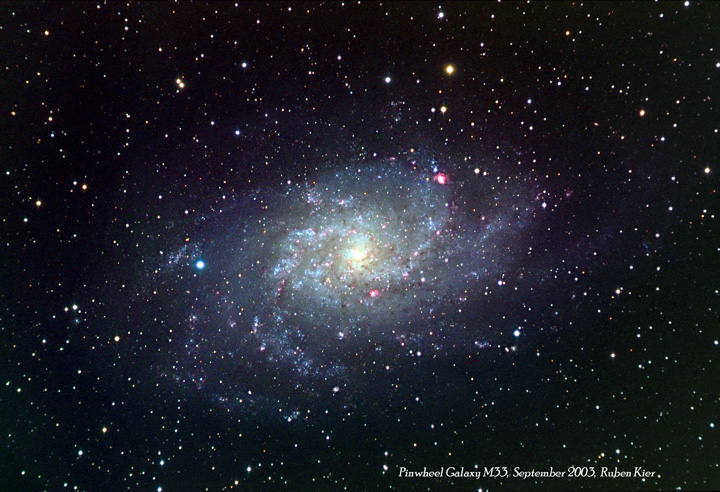
through a TEC 140mm refractor at the Hidden Lake Observatory. The image at bottom left was obtained from my light polluted backyard 6 years ago in September 2003. This
combined 75 one-minute luminence exposures, plus 12 red, 12 green, and 15 blue two-minute exposures, for a total imaging time of 2 hours 33 minutes. I used an ST-10XME
camera through a 4" refractor. The image on the bottom right was obtained with a 300mm camera lens and Kodak 1000 film, combining a 10 minute with a 20 minute exposure.
The image was taken in the pristine skies of Cloudcroft, New Mexico in November 2002.
Andromeda Galaxy, so it appears substantially smaller through binoculars and telescopes. Nonetheless, even a small telescope at a dark site can detect the spiral arms. In this
detailed photograph, one can see a nebula, called NGC 604, at the 9:00 position from the nucleus of the galaxy. This region of hydrogen gas glows red, illuminated by 200 young
huge bright stars at its center. Although this nebula seems small in this image, NGC 604 is intrinsically 50 times larger than the famous Orion Nebula, but resides 2000 times
farther away in neighboring galaxy.
This image was obtained with a QSI-583wsg camera using a Lodestar guider, through a TEC140 refractor at the Hidden Lake Observatory. Twelve unbinned 10-minute clear
luminance exposures were combined with 4 10-minute exposures through each of red, green, and blue filters binned 2 x 2. Total exposure time was 4 hours.
Comparison views: The image below, obtained 3 years earlier, is a combination of 18 unbinned clear 5-minute luminance with 10% weight of 10 unbinned red 5-minute
luminance, plus 8 each red and green and 7 blue 5-minute exposures binned 2x2. Total imaging time totaled over 4 hours. Images were taken with an ST-10XME camera
through a TEC 140mm refractor at the Hidden Lake Observatory. The image at bottom left was obtained from my light polluted backyard 6 years ago in September 2003. This
combined 75 one-minute luminence exposures, plus 12 red, 12 green, and 15 blue two-minute exposures, for a total imaging time of 2 hours 33 minutes. I used an ST-10XME
camera through a 4" refractor. The image on the bottom right was obtained with a 300mm camera lens and Kodak 1000 film, combining a 10 minute with a 20 minute exposure.
The image was taken in the pristine skies of Cloudcroft, New Mexico in November 2002.


Music is Picard's Flute from Star Trek