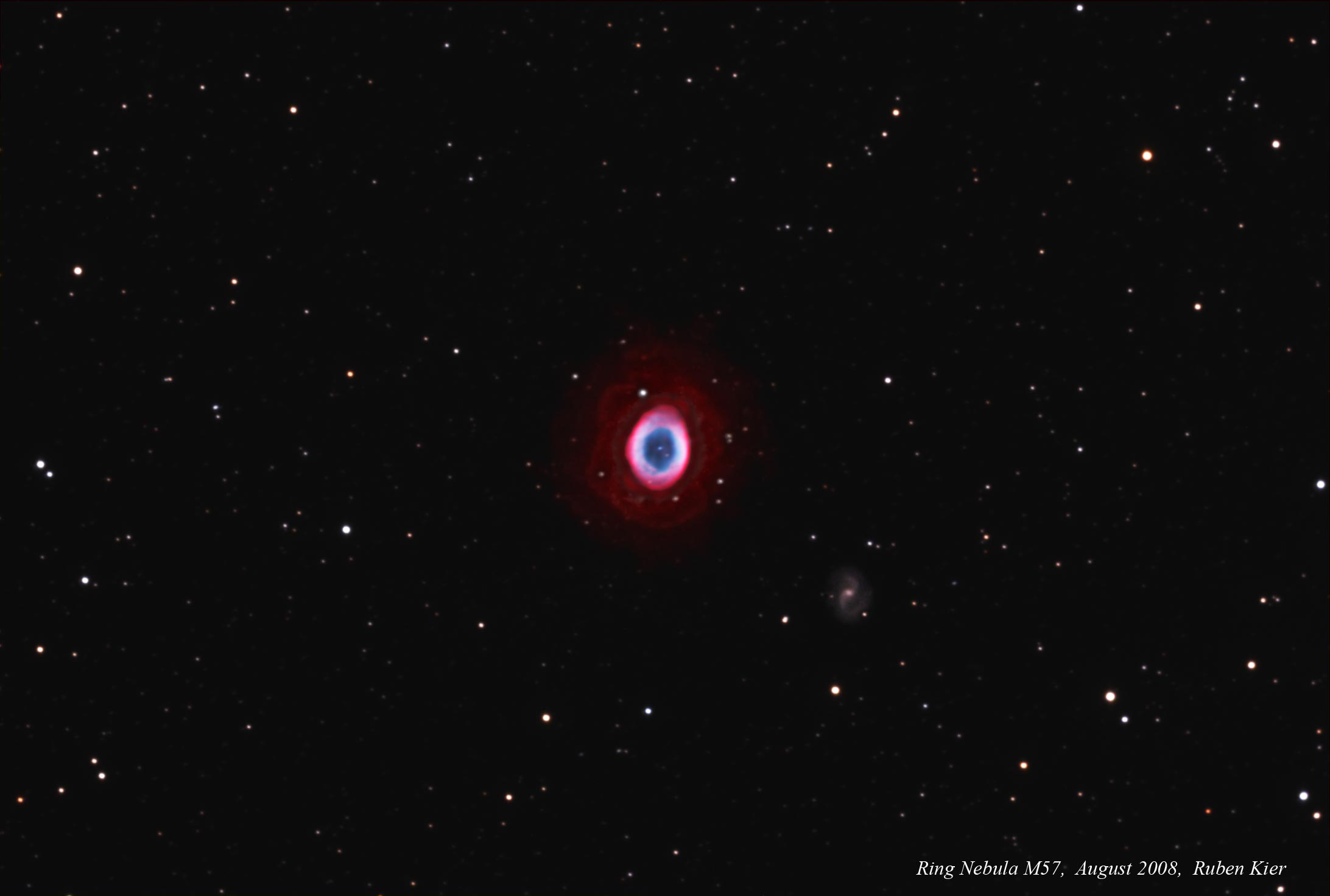
| The Ring Nebula |
Over two hundred years ago, the famous English astronomer William Hershel found the Ring Nebula to resemble the planet newly discovered by him, Uranus,
and so introduced the term “Planetary Nebula.� This class of objects, which are typically round, are created by dying stars that blow off their outer
layers, once their central supply of hydrogen is exhausted. The remnant central star is a dense "white dwarf," that can no longer support nuclear reactions.
Although this fate awaits our own sun, we have a few billion years before "the sun goes down" on us.
The Ring Nebula was the second “planetary nebula� to be discovered, in January 1779. The first was the Dumbbell Nebula, discovered fifteen years
earlier. This image combines 90 minutes H-alpha (binned 3x3) with 55 minutes red, 50 minutes green, and 55 minutes blue exposures (unbinned for RGB). I
used an ST10XME camera through a 12" Meade LX200R at f7, at the Hidden Lake Observatory.
The image has a surprise….look for the faint galaxy at the bottom that looks like a backwards “S.� Whereas the Ring Nebula is about 2000 light years
away, this galaxy (IC 1296) is about 200 million light years distant!
and so introduced the term “Planetary Nebula.� This class of objects, which are typically round, are created by dying stars that blow off their outer
layers, once their central supply of hydrogen is exhausted. The remnant central star is a dense "white dwarf," that can no longer support nuclear reactions.
Although this fate awaits our own sun, we have a few billion years before "the sun goes down" on us.
The Ring Nebula was the second “planetary nebula� to be discovered, in January 1779. The first was the Dumbbell Nebula, discovered fifteen years
earlier. This image combines 90 minutes H-alpha (binned 3x3) with 55 minutes red, 50 minutes green, and 55 minutes blue exposures (unbinned for RGB). I
used an ST10XME camera through a 12" Meade LX200R at f7, at the Hidden Lake Observatory.
The image has a surprise….look for the faint galaxy at the bottom that looks like a backwards “S.� Whereas the Ring Nebula is about 2000 light years
away, this galaxy (IC 1296) is about 200 million light years distant!


Music: Don't Let the Sun Go Down on Me