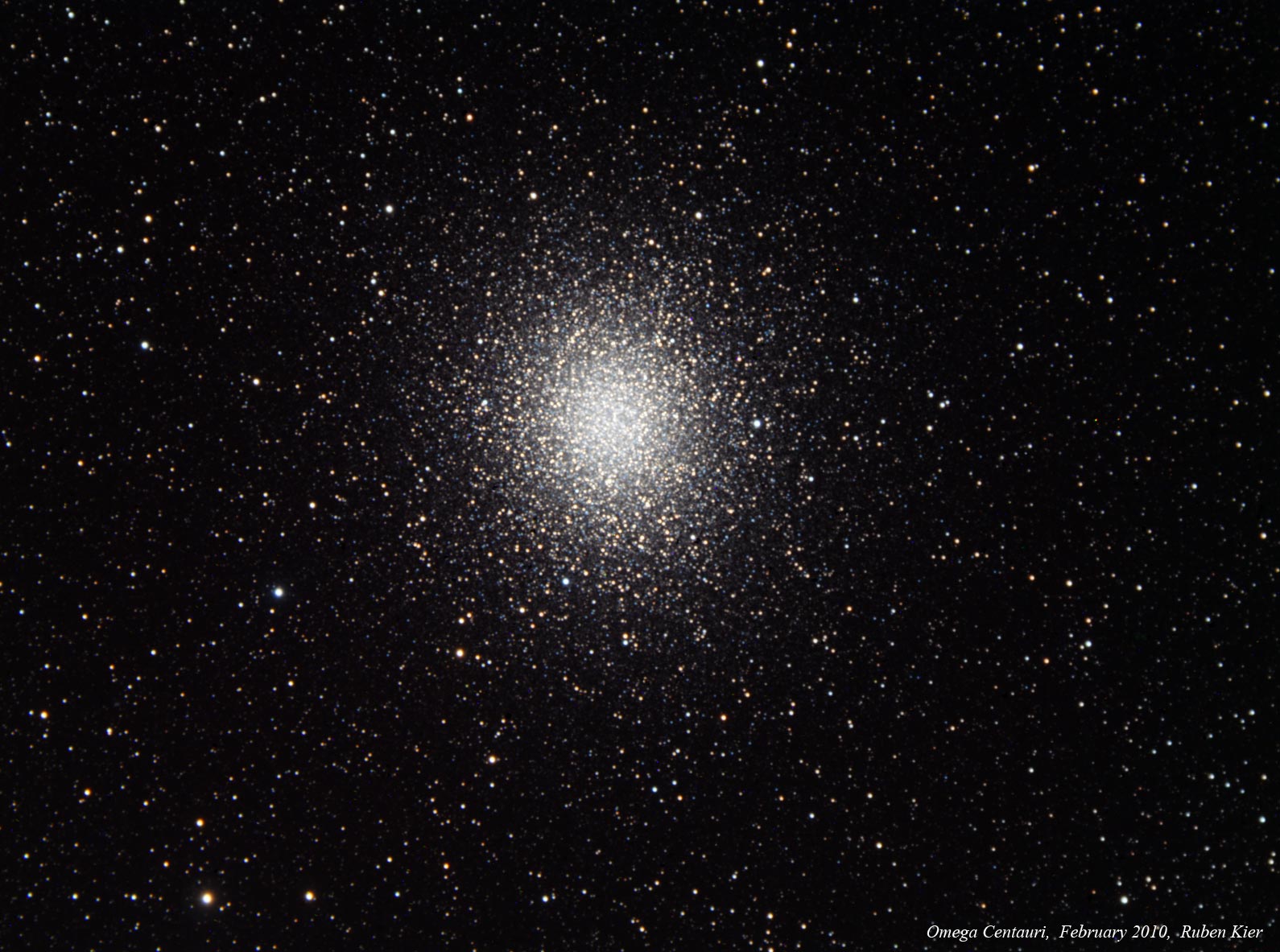
| Omega Centauri |
Omega Centauri is the largest and brightest globular cluster in the Milky Way Galaxy. At a distance of 16 thousand light years, it contains several million
stars and a central intermediate-mass black hole of about 40 thousand solar masses. Omega Centauri is so much larger than other globular clusters, that
some scientists suspect that in may have developed from the core of a dwarf galaxy that was captured by the Milky Way. Most globular clusters in the
Milky way have stars of a uniform age near 12 billion years, and similar chemical composition termed "metallicity." In contrast, Omega Centauri's stars
have a range of ages and metallicities.
At a declination below -47 degrees, Omega Centauri can usually be seen and photographed only from southern skies. For this photo, I traveled to the
Winter Star Party in the Florida Keys, at a latitude of 25 degrees north. This image combined 50 minutes of red, 30 minutes green and 25 minutes of blue
exposures, all unbinned. An ST2000XM camera was used through an Astro-physics 4" refractor at f/5 on an AP400GTO mount.
stars and a central intermediate-mass black hole of about 40 thousand solar masses. Omega Centauri is so much larger than other globular clusters, that
some scientists suspect that in may have developed from the core of a dwarf galaxy that was captured by the Milky Way. Most globular clusters in the
Milky way have stars of a uniform age near 12 billion years, and similar chemical composition termed "metallicity." In contrast, Omega Centauri's stars
have a range of ages and metallicities.
At a declination below -47 degrees, Omega Centauri can usually be seen and photographed only from southern skies. For this photo, I traveled to the
Winter Star Party in the Florida Keys, at a latitude of 25 degrees north. This image combined 50 minutes of red, 30 minutes green and 25 minutes of blue
exposures, all unbinned. An ST2000XM camera was used through an Astro-physics 4" refractor at f/5 on an AP400GTO mount.


Music: Beach Boys - Kokomo -
Off the Florida Keys
There's a place called Kokomo
That's where you wanna go
To get away from it all
We'll put out to sea
And we'll perfect our chemistry
By and by, we'll defy
A little bit of gravity
Off the Florida Keys
There's a place called Kokomo
That's where you wanna go
To get away from it all
We'll put out to sea
And we'll perfect our chemistry
By and by, we'll defy
A little bit of gravity